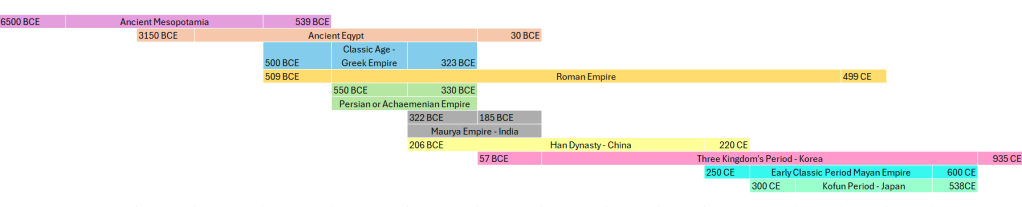
300 to 538 CE
The name of this period in Japan comes from the burial mounds that were created by the ruling classes during this time.1 Most of the references of clothing from this period come from sculptures which give us a limited view of what was worn. We know that they had access to wool, linen, hemp, and cotton.2 What we are able to see from the Haniwa sculptures is the warrior and riding clothing of the time.3
The lower level warriors would wear basic wrapped tops and tube pants tying them just below the knee and elbows to tighten the garments for easy movement while leaving enough space in the garments for bending.
- The Met, (2002, October), Kofun Period (ca. 300-710), Department of Asian Art, The Metropolitan Museum of Art, https://www.metmuseum.org/toah/hd/kofu/hd_kofu.htm
- Hoang, T., (2016, March 23), Kofun Period, World History, https://www.worldhistory.org/Kofun_Period/
- The Met, (Ret. 2024), Haniwa (hollow clay sculpture) of a warrior, The Metropolitan Museum of Art, https://www.metmuseum.org/art/collection/search/44833
- The Met, (Ret. 2024), Helmet, The Metropolitan Museum of Art,https://www.metmuseum.org/art/collection/search/23026

Virtual Exhibit
ArtPlacer
 Looking Back to Move Forward