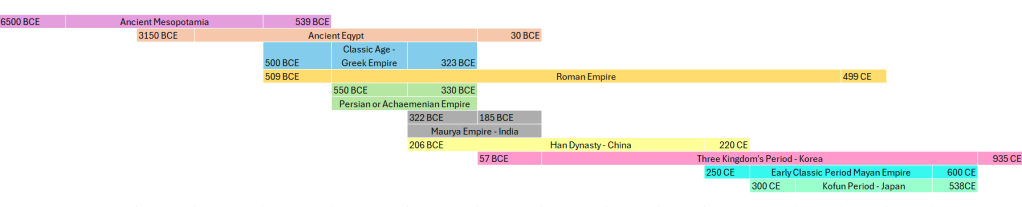
500 to 323 BCE
The clothing of the classic age in Ancient Greece was varied. While some garments were worn by both men and women there were several types of garments that were gender specific. This is different from many of the cultures that we’ve looked at where garments were much more unisex with some minimal changes. One of the garments of this period that was unisex is the chiton.1 This garment consists of two pieces of fabric that were tacked or pinned along the top edge in a few places with the sides left open. A belt would be added to secure the garment as it overlapped at the waist covering the wearer.
These garments were usually made of dyed linen in bright primary or secondary colours and embellished with linear embroidery. Men wore their chiton’s at knee length, whereas women usually worn them to the ankles.2 We can see many examples of this garment in Greek sculpture and vase paintings. They would often be paired with sandals or soft boots.3
- Nigro, J., (2022, February 1), Ancient Greek Dress: The Classic Look, Art Institute of Chicago, https://www.artic.edu/articles/966/ancient-greek-dress-the-classic-look
- Mark, J.J., (2021, July 13), Ancient Greek Clothing, World History, https://www.worldhistory.org/article/20/ancient-greek-clothing/
- Department of Greek and Roman Art, (2023, October), Ancient Greek Dress, The Metropolitan Museum of Art, https://www.metmuseum.org/toah/hd/grdr/hd_grdr.htm
- Department of Greek and Roman Art, (Ret. 2024), Marble funerary statues of a maiden and a little girl, The Metropolitan Museum of Art, https://www.metmuseum.org/art/collection/search/254508

Virtual Exhibit
ArtPlacer
 Looking Back to Move Forward